

David Roberts MBA FCCA • GAP Consultants
10 October 2026 update · Sources checked 10 October 2026
Before approving next year’s plan, I would want a clear answer to three questions: when is cash lowest, which customers or activities earn an adequate contribution, and what commitments can the organisation safely make? A profitable annual budget can still conceal a difficult winter.
This edition focuses on the economic evidence released since our 3 October briefing and its implications for SMEs and mid-sized companies. It covers practical tax actions, living and working remotely abroad, and import and export trading. The deep dive turns those pressures into a rolling 13-week cash forecast and decisions on margins and commitments. Releases on 8 October are retained for context following our early publication that day; they are not presented as fresh news on 10 October.
In this edition
Economic developments and the implications for costs, demand and funding
SME tax actions and living or working remotely abroad
Import and export trading for SME and mid-sized companies
When to start transformation and how to sequence it
Year-end preparation
The key steps in preparing the 2027 budget
Edition’s deep dive on protecting cash and margins
The business climate and its practical consequences
The ONS business survey released on 8 October reports that 72% of businesses were concerned about energy prices and 73% about fuel prices in late September. Among businesses with at least 10 employees, 48% were concerned about supply chains over the next year. These are survey estimates of concern, not forecasts of actual cost increases, and are official statistics in development. [7]
My response is to review energy renewals, freight quotations and critical suppliers now. Record when prices expire, what is contracted and what remains an estimate. Test a delayed delivery and a higher replacement price together: the same disruption can reduce margin and increase the cash needed to complete an order.
Bank Rate remains 3.75% following the 17 September decision; August CPI inflation was 3.1%, released on 16 September. These are existing reference points, not new changes since the last briefing. Obtain current borrowing and supplier quotations rather than assuming that Bank Rate or headline inflation describes your own costs. [8, 9]
The Bank of England’s Credit Conditions Survey published on 8 October reports reduced credit availability for small and medium-sized businesses in the three months to end-August, while overall corporate availability was unchanged. It reflects lenders surveyed from 17 August to 4 September, not a real-time reading of October conditions. My response is to confirm facility headroom and renewal requirements early, with a cash forecast and evidence of how the business will repay. An expected new facility should not fund a commitment until it is agreed. [15]
For charities, map grant instalments against payroll, delivery commitments and funding restrictions. Test whether fixed grants still cover full delivery costs. An award is not available cash until its conditions and timing are understood; restricted funds must be used for their specified purposes. [6]
The Autumn Budget is scheduled for 28 October. I would keep a dated assumptions register and arrange a review after confirmed announcements. Identify measures affecting payroll, purchasing, funding and investment, their effective dates and the person responsible. There are no assumed Budget tax changes in this edition. [1]
Legislation and reporting changes requiring action
Keep an obligations register with the applicable entity, effective date, owner and evidence of completion. The dates below distinguish current requirements from scheduled changes; HR, finance and the company secretary should confirm their own scope and jurisdiction.
Employment: tribunal claim limits increased from three to six months on 1 October 2026, with the Scottish contract-claim exception due on 9 November. The government schedules stronger harassment prevention duties, third-party harassment protections and trade-union measures for 30 October; six-month unfair-dismissal qualification and uncapped compensatory awards for dismissals from 1 January 2027. HR should update risk assessments, manager training, probation and record retention. Future dates remain subject to parliamentary processes. [2]
Financial reporting: the principal FRS 102 Periodic Review 2024 changes apply to periods beginning on or after 1 January 2026. Confirm transition treatment, lease schedules and revenue evidence with your accountant or auditor. Explain covenant and presentation effects separately from cash. UK small entities also need the applicable related-party disclosures. [3, 11]
Charities: SORP 2026 applies to relevant periods beginning on or after 1 January 2026. Changed England and Wales accounting and scrutiny thresholds apply to years ending on or after 30 September 2026; confirm the accounts and examination or audit required. New lease-accounting guidance published on 8 October covers lease identification, exemptions, general leases and peppercorn or social donation arrangements. Gather property and equipment agreements now, including subsidised arrangements, and agree their treatment with your adviser. [10, 16]
Companies House: verify directors and supply their personal codes for each company’s next confirmation statement. Check each PSC’s separate 14-day period on the register. A director who is also a PSC must provide details for both roles; filing the confirmation statement early does not move the PSC window. Assign an owner and retain filing evidence. [4]
Imports and exports: HMRC sets 1 January 2027 as the start of UK CBAM for specified aluminium, cement, fertiliser, hydrogen, iron and steel goods. Importers should check commodity codes, registration scope and emissions evidence, then review 2027 prices and supplier terms. Exporters should confirm customs responsibilities, licences and evidence before committing a delivered price. [5, 12]
After the Budget, turn applicable confirmed measures into an action list with effective dates and owners. Our 31 October edition will focus on the first 30 days of implementation and link to specialist guidance where needed.
Tax actions for SMEs
HMRC’s 5 October reminder highlights the extension of Making Tax Digital for Income Tax to qualifying sole traders and landlords from 6 April 2027. This is a preparation reminder for an existing timetable, rather than a new tax rate. [17]
For sole traders and landlords, qualifying income means combined gross self-employment and property income before expenses. More than £50,000 on the 2024/25 return brings a person into the April 2026 intake; more than £30,000 on the 2025/26 return brings them into April 2027, subject to exemptions. Check scope with your adviser, confirm compatible software and make record reconciliation routine. This is not a Corporation Tax requirement for limited companies. [18]
For those already in the 2026 intake, the second quarterly update is due by 7 November 2026. Reserve time now to reconcile bank records and categorise transactions. Quarterly updates do not create quarterly tax-payment deadlines; retain the actual payment dates in the cash forecast. [18]
For limited companies, the standard non-ring-fence Corporation Tax rates remain 19% for eligible small profits and 25% at the main rate, with marginal relief between the limits. The usual £50,000 and £250,000 limits can be reduced for associated companies and short accounting periods. Ask your accountant to refresh the provision when profits or the group structure change, and schedule the actual payment. These are existing rules, not announcements since 3 October. [19, 20]
Before committing to equipment or recruitment, compare the business return, implementation cost and cash timing. Confirm any tax relief and eligibility separately. A tax saving does not make an unfunded purchase affordable. After the Budget, change only the assumptions affected by confirmed measures, from their effective dates.
Living abroad and working remotely
A move abroad needs two reviews: your personal tax position and the business or employer’s obligations. A UK customer, UK bank account or UK employment contract does not by itself determine where income is taxable. The country where duties are physically performed matters. [21, 22]
Personal residence: apply the UK Statutory Residence Test to the whole tax year, including days, work, homes and ties. Fewer than 183 UK days does not automatically make you non-resident. UK residents normally face UK tax on worldwide income, subject to applicable reliefs; non-residents can still have UK-source liabilities. Check host-country residence, treaty relief and any split-year treatment with an adviser covering both jurisdictions. Keep a travel and workday record. [21, 23]
Employees: the employer should review UK PAYE, host-country payroll and social-security requirements before approving the arrangement. HMRC says to continue operating PAYE unless the applicable tax treatment or HMRC instruction permits a change. National Insurance and overseas social security require a separate review; check whether a certificate of coverage is available. Do not treat an overseas address as permission to stop deductions. [22]
Owner-managers and contractors: examine where decisions are made, contracts negotiated and services delivered. A recurring overseas work base can require a review of local business registration, a taxable permanent establishment or company residence. These depend on host-country law, the relevant treaty and the facts; they are not settled by the individual’s UK residence result. Arrange country-specific advice before making the location permanent.
HMRC guidance updated on 8 October gives examples of overseas employees working in the UK and shows why recurring presence needs a business-tax review. It concerns inbound UK situations and is not a universal rule for UK businesses working abroad. My practical conclusion is to approve overseas work against a written country assessment, with an owner, work locations, dates and budget for compliance. [24]
Import and export trading for SMEs and mid-sized companies
The 8 October ONS survey reinforces the supply-chain risk: 48% of businesses with at least 10 employees reported concerns for the year ahead, with international conflict and shipping disruption prominent. This is evidence of concern, not a measured increase in your own freight bill. Reprice priority routes using current quotations and test delayed arrival alongside later customer collection. [7]
Imports: refresh landed cost by product and route, including freight, insurance, duty, clearance, currency and storage. Check the current commodity code, customs value and origin evidence before claiming a preferential tariff. Buying from a trade-agreement country does not by itself establish origin. Record who is importer of record and what the customs agent is authorised to do. [25, 26]
Import VAT: UK VAT-registered businesses may use postponed VAT accounting where conditions are met, accounting through the VAT return rather than paying import VAT at the border. Confirm declaration instructions and reconcile monthly postponed VAT statements or C79 evidence. This can reduce a funding gap but does not remove customs duty or change the conditions for VAT recovery. [27]
Exports: check destination tariffs, product rules, licences and sanctions for the actual shipment. Agree who pays import charges and completes clearance before quoting a delivered price. Retain evidence supporting VAT zero rating: export and evidence deadlines are normally three months, with specified exceptions. Use the destination’s live tariff guidance and your broker for US or other changing tariff exposures; do not assume one blanket rate. [5, 28]
UK CBAM starts on 1 January 2027 for specified goods in aluminium, cement, fertiliser, hydrogen, iron and steel. Check covered commodity codes now. Registration tests include expected covered imports of £50,000 or more in the next 30 days and a retrospective 12-month test; pre-2027 imports are excluded. Obtain emissions information and assess 2027 landed costs before signing annual supply terms. This confirmed future obligation is not a new October tax charge. [12, 29]
For an SME, start with the five products or routes that create most margin or cash exposure. A mid-sized company should assign an owner across procurement, sales, finance and customs, with one consistent product and origin record. Before accepting an order, confirm landed margin, deposit and payment terms, delivery contingency and funded cash exposure. Where growth needs an overseas operation, use the establishment checklist linked later in this edition.
Transformation that supports the trading plan
The 8 October ONS survey reports that 30% of businesses used AI in September. For importers and exporters, I would first improve the information needed to decide: stock in transit, landed cost, order margin, customs evidence and cash timing. Apply the same discipline across international expansion, business and finance transformation, not-for-profit sustainability, and independent finance systems and AI. Require reconciled data, tested controls, trained users and a contingency before go-live. [7]
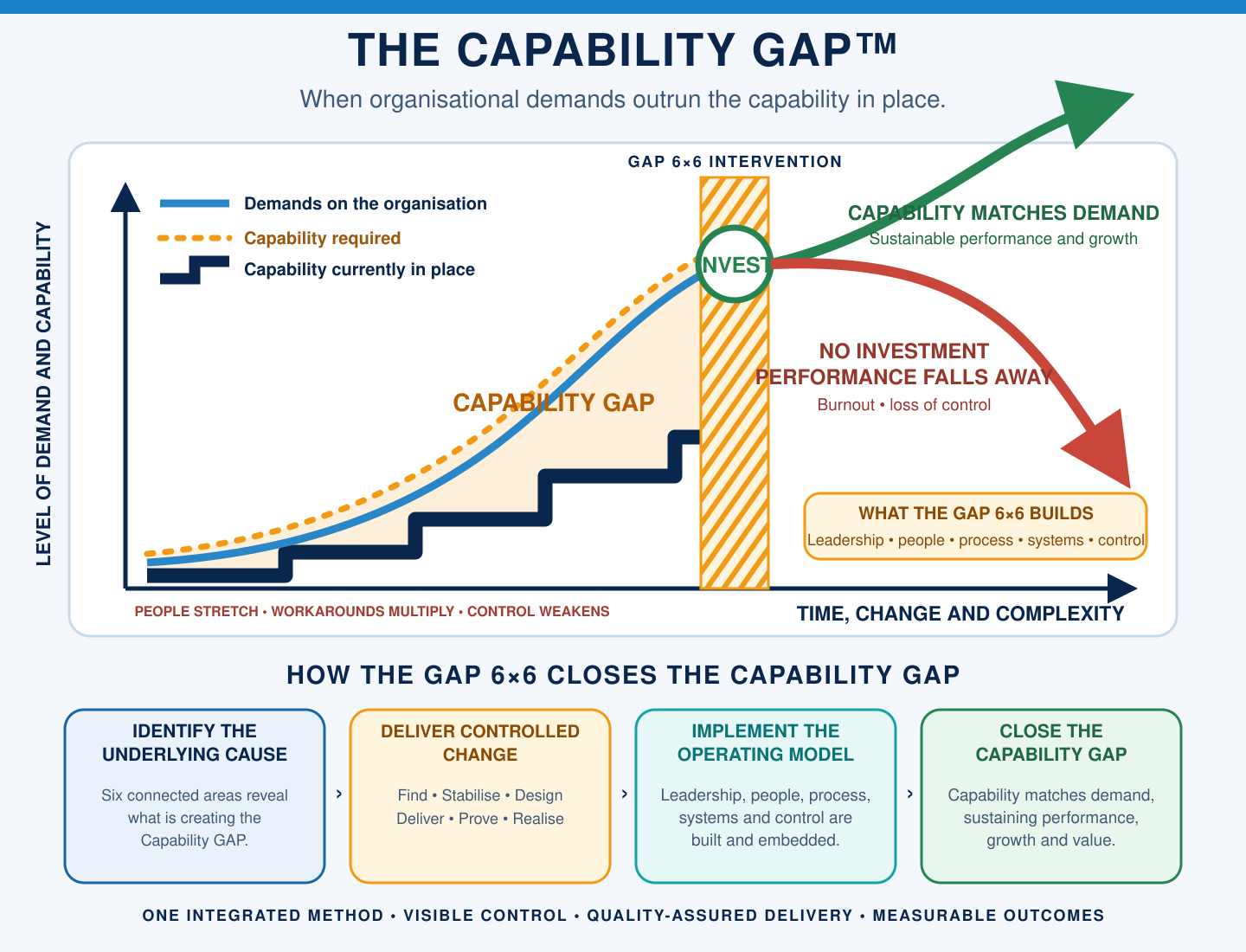
The growth curve shows why capability must keep pace with demand. Use it to ask what extra leadership, people, processes, systems and control the next stage requires.
Year-end work and preparation
For a December year-end, use the remaining weeks to remove avoidable surprises. Finance should coordinate the timetable with operations, payroll and those responsible for audit evidence.
Reconcile the balance sheet now. Assign old debt, disputed invoices, unallocated receipts and suspense items to named owners. Separate genuine collection risk from administrative delays.
Set stock and work-in-progress responsibilities. Agree count dates, valuation evidence, slow-moving stock reviews and checks on unbilled work.
Review estimates and cut-off. Prepare evidence for accruals, provisions, grant recognition and revenue acceptance conditions.
Confirm liquidity evidence. Align the cash forecast with debt maturities, covenants, tax payments and downside assumptions.
For charities, reconcile funds and commitments and identify cash available for unrestricted obligations. Confirm the reporting and scrutiny requirements for the year, refresh trustees’ reporting on reserves and future plans, and include lease evidence in the close timetable. [6, 10, 16]
Reserve review time. Give auditors or independent examiners a credible timetable and keep decision evidence alongside the numbers.
Key steps for the 2027 budget
Build the annual plan from the latest outturn, then challenge the cash and capacity needed to deliver it. A Budget announcement should change only the assumptions to which it applies, with its effective date and source recorded.
Bridge 2026 to 2027: separate recurring activity, delayed work, one-off costs and vacancies.
Evidence income: distinguish contracted business, renewals and uncommitted pipeline; model grant or contract timing.
Cost delivery: include people, working capital, systems, compliance and implementation effort. Show who will deliver savings or growth, how much of their time is available and what cover or training is needed. Include applicable employment, reporting and import requirements from the correct date.
Integrate the forecasts: reconcile profit or surplus, balance sheet and monthly cash; retain the weekly view for near-term pressure.
Agree funded priorities: name owners and dates, test the downside and set triggers for changing course.
The board should approve both the financial plan and how it will be delivered. Put the major commitments, people needed, funding and decision dates on the same page. Agree what evidence would cause a change of course and who has authority to act.
Edition’s deep dive topic
In each edition, we take a deeper look at a particular business topic. Questions and suggestions for future topics are welcome at David.roberts@gapconsult.co.uk.
Protecting cash and margins before committing to 2027
Start with 13 complete forecast weeks from Monday 12 October 2026 to Sunday 10 January 2027. Give one finance owner responsibility for compiling the view and agree a weekly review with those who can change collection, purchasing and delivery decisions.
1 Establish what cash is available
Reconcile opening bank balances to the ledger. Identify restrictions and minimum balances separately. Show committed facilities, their conditions and available headroom without treating an unapproved facility as cash. For a charity, distinguish restricted funds, designated funds and genuinely available unrestricted cash.
2 Forecast receipts when they can be collected
Schedule material customer receipts against invoices, due dates, disputes and current collection evidence. Ask sales or account owners to confirm the largest assumptions. Include new orders only when billing and payment triggers are credible. For grants, show instalments and conditions; distinguish an award letter from an approved payment.
3 Put payments in the week they fall due
Map payroll, suppliers, rent, tax, loan payments, capital expenditure and programme obligations. For cross-border trade, put supplier deposits, freight, customs duty and any import VAT paid at entry in their actual weeks; keep tax recovery timing separate. Include the cost of overseas payroll or compliance where applicable. Start with purchase orders and contracts, and give uncertain dates and amounts an owner.
4 Reconcile and test the low point
For every week, calculate opening cash plus receipts less payments to give closing cash. Carry that closing balance into the next week. Reconcile forecast movements to the annual plan, explain differences and test slower receipts, delayed grants and higher supplier costs. Focus on the lowest headroom and the date it occurs.
Illustrative only: if a £150,000 receipt moves from week three to week six, the cash view must show the full temporary £150,000 reduction in those intervening weeks. An unchanged annual profit does not remove that funding need.
5 Connect cash to customer and activity margins
Review contribution by customer, product, contract or programme. For traded goods, use the full landed cost and allow for currency, customs and delivery terms. Include direct costs, incremental delivery costs, financing and support costs. Use full cost for longer-term pricing decisions and relevant incremental cost for a specific short-term decision. Test margin and the peak cash requirement together.
For a charity service, identify any unrestricted subsidy explicitly. Where pricing or grant terms are fixed, consider scope, delivery method, funding discussions and capacity before committing more resource.
6 Decide what to change and who will act
Collections: resolve acceptance and invoice disputes, confirm collection dates and agree deposits or milestone billing on new work.
Stock and purchasing: challenge quantities and timing, review surplus stock and align commitments with evidenced demand.
Pricing and scope: address loss-making terms and unpriced changes through the contract process.
Recruitment and investment: approve commitments against the downside cash view and actual capacity to implement them.
Funding: begin discussions before headroom becomes tight; provide reliable forecasts and evidence of the proposed actions.
Agree a board-approved minimum cash threshold and triggers suited to the organisation. When a trigger is reached, specify the action, owner and deadline. Do not assume that all expenditure can be deferred; contractual and statutory obligations need to be respected.
7 Make the weekly review useful
Compare actual receipts and payments with last week’s forecast. Explain material differences, change the remaining weeks and add a new thirteenth week. Track the few actions that can change the low point. Measure collection delays, stock exposure, contribution and funding headroom alongside the cash balance.
The output for the board should be one clear decision page: the lowest forecast cash, when it occurs, the downside position, commitments proposed and the actions needed. Detailed workings remain available behind it.
Your next ten working days
By Friday 23 October, reconcile opening cash, confirm major receipts and test the low point. Review the most exposed products or contracts, landed margins and overseas commitments. Confirm applicable tax and reporting dates, prepare the 7 November MTD update where required, and assign owners to the assumptions to revisit after the 28 October Budget. Carry agreed actions into the 2027 plan.
GAP 2027 delivery readiness study
Can your organisation deliver its 2027 plan? Our five-minute survey is open through 22 October 2026. It asks your broad sector and eight fixed-choice questions on cash, reporting, margins and delivery capacity, without requesting names, organisation details, emails or detailed budgets. Please submit once per organisation.
We will examine how funding headroom, reliable information and delivery capacity interact within the responding group. Findings will be shared in aggregate when there are enough responses for useful comparisons, with small groups combined or withheld. A voluntary survey gives an indication of respondents’ experience rather than a representative measure of the whole market. Responses are separate from subscriptions and support enquiries; storage and website-log details are explained on the survey page.
Take the five-minute readiness survey
Practical guides added this week
Published on 8 October, these four guides take the questions above into the work needed to deliver the decision. They draw on completed finance leadership and implementation assignments, with client examples anonymised.
Setting up overseas — A finance checklist covering the business case, funding, local advice, controls and launch readiness.
The first 100 days after an acquisition — A sequence for continuity, reporting, the operating model and transition to business ownership.
Charity sustainability beyond reserves — A review of cash, service economics, cost recovery and the decisions trustees need to make.
Finance systems improve or replace — A comparison of full cost, delivery capacity, readiness and a controlled approach to AI.
One lesson from delivery: my overseas subsidiary, carve-out and integration work has shown why legal completion or registration needs to be followed by functioning finance. The same principle applies in charities: a funded plan needs dependable income records, service costs, cash and people able to act. The guides explain how to make those connections.
Subscribe and join the conversation
The Capability Gap Briefing is published every other Saturday. What decision would you like a future deep dive to help you make? Send a topic or question using the link below; we will announce selected topics with their planned edition date.
The email subscription form includes an optional question or future topic suggestion. You can also use the separate question link without subscribing.
Send a question or suggest a future topic
For help with overseas establishment, integration, charity sustainability or finance systems, tell us the decision you face, the outcome needed and your deadline. GAP can help establish the facts, agree priorities and support implementation, with ongoing part-time finance leadership where useful. Scope, fees and availability are agreed first.
Publication timetable
This 10 October update supplements the edition released early on 8 October. The regular every-other-Saturday programme resumes on 31 October, then 14 November, 28 November, 12 December and 26 December 2026; followed by 9 January 2027.
Proposed next deep dive topics
31 October: After the Autumn Budget your first 30 days of action. Confirm which measures apply, revise assumptions from the correct date and assign finance, HR and operational owners.
14 November: Turning the 2027 budget into a deliverable business plan. Convert the refreshed forecast into funded priorities, capacity, measures and decision triggers.
28 November: Preparing the year-end close and January cash position. Connect service or contract profitability, cost recovery, accounting transition and collection risks before holiday absences reduce the time available to act. Reader suggestions may shape the scope.
Sources and publication notes
[1] HM Treasury: Budget 2026 date
[2] Government: Employment Rights Act implementation timetable
[3] FRC: FRS 102 and Periodic Review 2024
[4] Companies House: identity verification due dates
[5] Government: Export goods from the UK
[6] Charity Commission: improving your charity’s finances (England and Wales)
[7] ONS Business Insights and Conditions Survey released 8 October 2026
[8] Bank of England Bank Rate decision 17 September 2026
[9] ONS Consumer price inflation August 2026 released 16 September
[10] Charity Commission Changes to charity accounting and reporting
[11] FRC Periodic Review 2024 key changes
[12] HMRC Carbon Border Adjustment Mechanism
[13] ONS August GDP release scheduled 15 October 2026
[14] ONS Labour market overview September 2026 released 15 September
[15] Bank of England Credit Conditions Survey published 8 October 2026
[16] Charity Commission Lease accounting helpsheet published 8 October 2026
Tax and trade sources
[17] HMRC MTD preparation reminder published 5 October 2026
[18] HMRC MTD scope and quarterly update dates
[19] HMRC Corporation Tax rates
[20] HMRC Marginal Relief and associated companies
[21] HMRC Statutory Residence Test
[22] HMRC employees working abroad
[23] HMRC tax on foreign income
[24] HMRC remote working examples updated 8 October 2026
[25] HMRC customs preferences for imports
[26] HMRC export rules of origin
[27] HMRC postponed import VAT accounting
[28] HMRC VAT Notice 703 export conditions and evidence
[29] HMRC CBAM registration tests
Sources checked on 10 October 2026. New releases since 3 October are distinguished from existing rules and scheduled changes. August GDP is due on 15 October, the next labour-market release on 20 October and September CPI on 21 October; none is treated as published here. Tax treatment depends on entity, activity and jurisdiction. Country-specific arrangements should be confirmed with the relevant advisers. [1, 9, 13, 14]